Twelve Record Companies Sue Suno Again, This Time Over 60,202 Recordings
The labels behind Capitol, Arista and Zomba filed a second copyright complaint against the artificial intelligence music company Suno on 18 September, after a judge refused to let them expand their 2024 suit to cover the works.

Twelve record companies led by UMG Recordings and Sony Music Entertainment filed a new copyright complaint against Suno on 18 September 2026 in the United States District Court for the District of Massachusetts, docket 1:26-cv-14275-FDS, asserting rights in 60,202 sound recordings they say were copied to build the models behind its generative music service.
The caption names ten further plaintiffs alongside the two majors: Capitol Records, Alamo Records, Arista Music, Arista Records, LaFace Records, Records Label, Sony Music Entertainment US Latin, Ultra Records, Volcano Entertainment III and Zomba Recording. The filing runs to 45 pages, pleads three causes of action and demands a jury trial. Every claim in it is an allegation. No court has held that Suno infringed anything, and Suno has not yet answered this complaint.
The opening paragraph of the complaint sets out what the labels think the case is about.
"This is the second action brought by two record companies and their affiliates to vindicate their rights in the enormous number of copyrighted sound recordings that Suno copied without permission to train the commercial artificial intelligence ('AI') models that power its generative AI service."
Why there are suddenly two cases
The same labels sued Suno in the same court in June 2024, and the complaint calls that case the Original Action throughout. Rather than fold the new works into it, the plaintiffs asked to amend, seeking to add more than 61,000 further recordings. According to the complaint, the court refused on 18 August 2026, without prejudice, primarily because the amendment would have disturbed the case schedule, and concluded that parallel cases best balanced the competing interests.
The complaint quotes the court's order directly.
"Plaintiffs are of course entitled to pursue valid claims for copyright infringement, and the magnitude of the alleged infringement is not a defense."
So the second suit exists because the first one could not hold the works. The order itself has not been read here in full; what is quoted above is the passage the complaint reproduces.
How the labels say they arrived at 60,202
The complaint describes a counting exercise carried out inside the first case. In discovery, the plaintiffs say they inspected Suno's source code and training data in secured rooms at the offices of Suno's outside counsel, and fingerprinted the audio files using Audible Magic, the matching technology the complaint says courts have accepted. The matches, the complaint alleges, ran to millions of files.
The 60,202 recordings are listed in an exhibit and defined as the Universal Works and the Sony Works. The complaint is explicit that the list is illustrative rather than complete.
"However, the scope of Suno's infringement goes far beyond the 60,202 works listed in Exhibit A, which represent only a fraction of Suno's illegal activity."
The recording artists behind those 60,202 tracks are not identified in the body of the complaint, and the exhibit itself is not part of the document read for this piece. No artist can be placed on that list.
The count about downloading from YouTube
The third cause of action is the unusual one. Alongside direct infringement, and a separate count covering pre-1972 recordings, the labels plead circumvention of technological measures. The complaint alleges that Suno used the tools YT-DL and YT-DLP to get around YouTube's rolling cipher encryption and pull recordings down from Official Artist Channels, a practice the filing calls stream ripping.
It also draws on what it describes as Suno's own internal records, as set out in a technology-news report from July 2026 and cited in the complaint. Those records are said to include a scraping instruction naming the sources genius_hq, youtube_music, freesound, jamendo, imp, deezer and ytm_tagged, a file named youtube_music recording 2,013,545 music clips, and dataset logs recording 113,879 hours of audio from YouTube Music plus a further 152,162 hours of tagged YouTube Music audio, with the scraping routed through commercial proxy servers. Per the complaint, Suno did not deny the code and described the material as "outdated source code that is no longer in use".
The pre-1972 count turns on the Music Modernization Act. The complaint pleads that all the older recordings asserted have been submitted to and publicly indexed by the Copyright Office under section 1401, which is what makes statutory damages available for recordings made before federal copyright covered sound recordings at all.
What the labels are asking a jury for
The prayer for relief seeks statutory damages in an amount up to $150,000 per work infringed, and statutory damages in an amount up to $2,500 with respect to each act of circumvention, or in the alternative actual damages and Suno's profits, together with costs, attorneys' fees and pre-judgment and post-judgment interest. The labels also want a preliminary and permanent injunction requiring Suno to stop circumventing YouTube's technological measures and to stop infringing the recordings in the exhibit.
The complaint states no total. It also does not say how many separate acts of circumvention it will allege, so the exposure on that count cannot be sized from the document.
The argument about the market
Much of the filing is built to show that a licensing market for training already exists, and that Suno chose not to use it. It points to deals with Warner Music Group in November 2025, BMG announced on 12 August 2026 and Believe announced on 8 September 2026. Suno's chief executive, Michael Shulman, is quoted at paragraph 3: "I don't just want to build a company that makes the current crop of creators 10 percent faster or makes it 10 percent easier to make music. If you want to impact the way a billion people experience music you have to build something for a billion people." The line comes from a podcast interview in January 2025.
Suno released its v6 models on 9 September 2026 and said they were built with licensed music from Warner Music Group, BMG and Believe, with earlier models retired. The complaint disputes that this makes v6 clean, alleging on information and belief that it was developed using the plaintiffs' recordings, that Suno retains unauthorised copies, and that v6 was trained on user interactions with earlier models. That allegation is unresolved.
On scale, the complaint cites Deezer's July 2026 report that machine-generated tracks passed half of all daily new music deliveries to its platform for the first time, roughly 90,000 a day, up from about 39 percent six months earlier. It says Suno told investors its users create a Spotify catalogue's worth of output every two weeks. On fair use it pleads all four statutory factors and calls the use quintessentially commercial and non-transformative.
What has not happened yet
Suno has made no public statement responding to this specific complaint that this account could find. Its position on the record remains the fair use defence it took in the first case, and its 9 September statement that v6 is built on licensed music. No hearing date, no consolidation order and no trial date has been set. Whether any of this is true is now a question for a jury, if it gets that far.
More from Music

Stella Lefty Has the Number Two Single in America and Two Separate Arguments to Answer
The 24-year-old's rise was first questioned because of who her father is, and is now being questioned because of what her chorus sounds like.
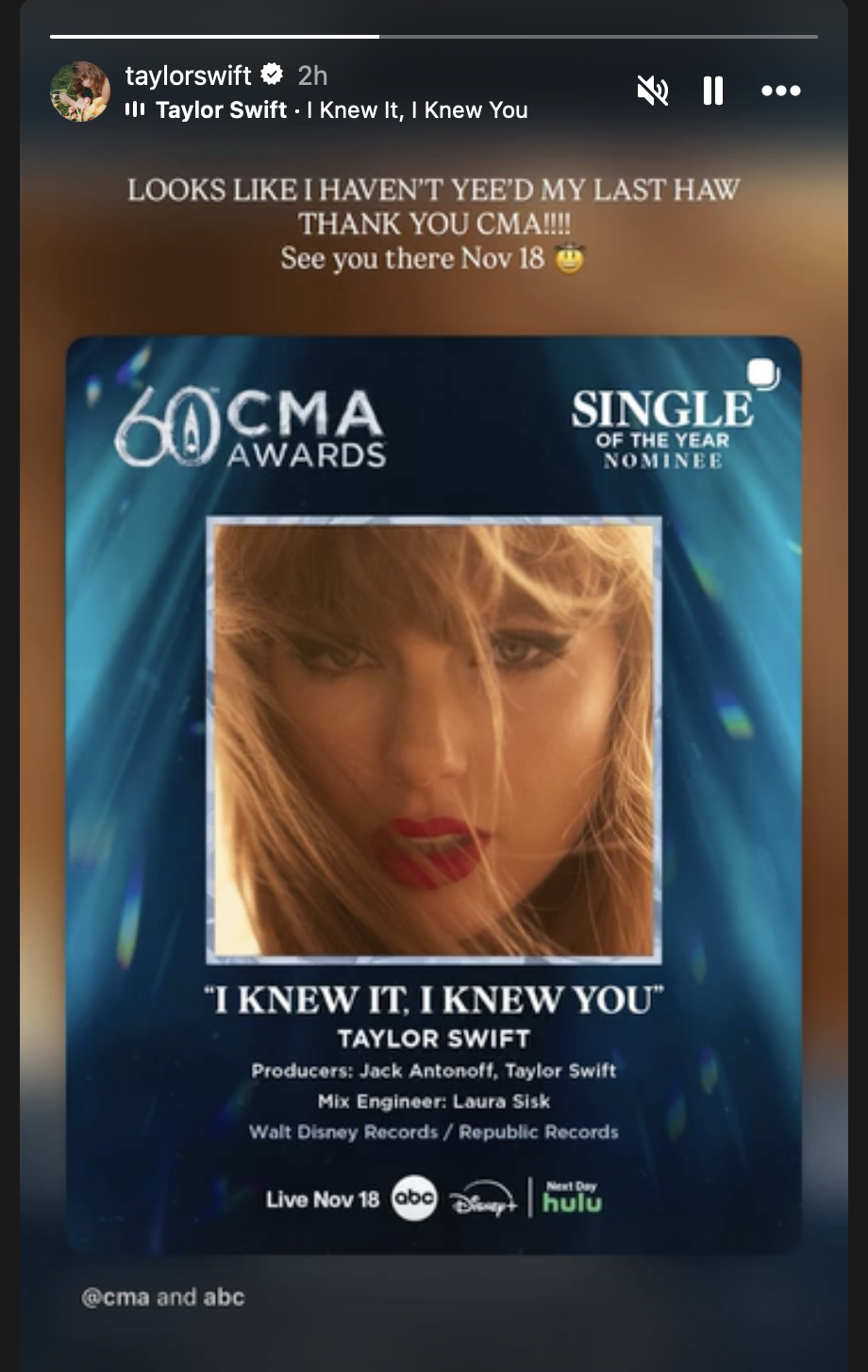
Taylor Swift Will Attend the CMA Awards for the First Time in a Decade
She normally leaves everyone guessing about award-show appearances, and this time she confirmed within hours of the nomination being announced.

Ella Langley Took Nine CMA Nominations and Came One Short of a Record Set in 2002
The scale of her year is clearest not in her own nine nominations but in how many other people were nominated for work they did on her records.