At Christie's, the paper beat the wood
Johnny Marr's collection made £3,649,280 from 111 lots on 17 September, and the sale's biggest multiples were not guitars at all but concert posters and record-industry sales awards.
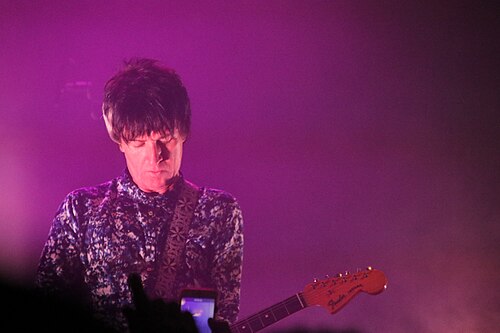
Christie's offered 111 lots from Johnny Marr's personal collection of guitars, amplifiers, posters and sales awards at 8 King Street in London on 17 September, in a live auction, sale number 24434, "Marr's Guitars: The Johnny Marr Collection". The sale realised £3,649,280. One lot failed to sell. According to Christie's post-sale release it ran over five hours and drew registrants from 34 countries, 81 per cent of them new to the house.
The top lot was lot 5, a 1982 Rickenbacker 330 Jetglo that Marr bought in Manchester in around June 1983 with his first publishing advance. The catalogue entry has him using it to write and record 'This Charming Man' and 'Still Ill', and across The Smiths' debut album. It carried an estimate of £60,000–80,000 and realised £358,400 after a contest Christie's says ran more than five minutes. That single lot is 9.8 per cent of the sale total. The top ten lots together are 39.3 per cent.
Lot 1, a 1980 Gibson Les Paul Standard estimated at £5,000–8,000, opened the sale at £35,840, more than seven times its low estimate.
What the room was actually buying
Read all 110 published results against their estimates and the pattern has very little to do with guitars.
The 21 poster and sales-award lots that sold carried a combined high estimate of £27,800 and made £245,760 between them, which is 8.84 times high estimate. The 75 guitar lots that sold made 2.25 times their combined high estimate. The 11 amplifier lots made 3.88 times.
The nine largest multiples in the entire sale were plaques and posters, not instruments. Lot 39, a BPI sales award for The Queen Is Dead, was estimated at £1,000–1,500 and made £25,600, seventeen times high estimate. Lot 31, the award for Meat Is Murder, made £24,320. Lot 52, for Strangeways, Here We Come, made £23,040. Lots 19 and 53 made £19,200 each.
Recent guitars did it too. Lot 108, a 2021 Fender Johnny Marr Signature Jaguar estimated at £8,000–12,000, made £60,160, five times its high estimate. Lot 75, a 1957 Gibson Les Paul Gold Top estimated at £40,000–60,000, made £61,440. The two finished £1,280 apart on estimates a factor of five apart. Lot 102, a 2017 Signature Jaguar in Comet Sparkle used to record the James Bond Theme on Hans Zimmer's No Time To Die soundtrack, made £46,080 against the same £8,000–12,000 estimate, with eleven bidders competing for almost five minutes more than five hours into the sale.
The lots that lagged were the ones without a story
No lot in the sale sold below its low estimate. Only three sold below their high estimate, and all three were blue-chip vintage instruments with thin Smiths association: lot 64, a 1960 Gibson Les Paul Custom, £76,800 against £60,000–80,000; lot 66, a Gibson ES-350 TDN, £23,040 against £15,000–25,000; and lot 45, a composite Fender Stratocaster, £53,760 against £40,000–60,000. The one unsold lot was lot 41, a 1962 Fender Bass VI estimated at £18,000–25,000. Christie's publishes its result as blank and gives no reason.
Put together, the sale priced association, not instruments. A certification plaque, a 1980s concert poster and a signature model built in 2021 carry no vintage scarcity at all. What they have is Marr's name on them, and that is where the multiples landed.
"The auction has been a great experience and has exceeded all my expectations. I'd like to thank everyone who made bids and special thanks to Christie's for making it so memorable."
That is Marr, in Christie's post-sale release.
How the total gets quoted
Summed across the catalogue, the pre-sale estimate for the whole sale was £1,020,900 to £1,533,600. Set against a £3,649,280 result, that is where the more-than-triple framing comes from.
The two figures are not built the same way, and Christie's says so on its own sale page: "Estimates do not include buyer's premium. Sales totals are hammer price plus buyer's premium."
In this sale the premium was 28 per cent, flat, on every lot. Each of the 110 published results is exactly 1.28 times a whole-pound hammer figure, and Christie's published saleroom photograph of lot 5 shows the same thing from the other direction: the currency board behind the rostrum reads GBP 280,000, against a published result of £358,400, which is 280,000 multiplied by 1.28.
That puts the hammer total at £2,851,000, with £798,280 of the headline figure being premium. Christie's does not publish that split; it is arithmetic on the house's own published total. Compared like for like, hammer against estimate, the sale made 1.86 times its aggregate high estimate. Premium-inclusive against the same estimate it is 2.38 times, and 3.57 times the low. All three statements are true. Only one compares two numbers measured the same way. This is standard convention across the trade rather than anything peculiar to this sale, but it is worth knowing which number you are reading.
The charity lots, and what nobody has published
Marr designated 31 lots, 10 guitars plus 1980s concert posters and sales awards, whose full hammer price goes to two charities, split equally between The Guide Dogs for the Blind Association and The National Autistic Society. Both Christie's release and the charity's own announcement are specific that the money is the hammer price, not the premium-inclusive price quoted in the results.
"As a charity we're almost entirely funded by donations; this will go a long way in helping people with sight loss live the life they choose."
Jo Stevenson, Head of Customer Experience at Guide Dogs, in Christie's post-sale release.
There is a discrepancy in the record over how many lots. The National Autistic Society's own June page said proceeds from 10 lots would be split between the two charities. Its post-sale page, and both Christie's releases, say 31. No document resolves it, and the likeliest reading is that the charity was describing only the 10 guitars.
Neither charity has published what it receives, and the total cannot be reconstructed from the lot list, because Christie's gives the number of charity lots without saying which ones they are.
What is not on the record
Christie's names no buyer, so whether the Rickenbacker went to an institution, a collector or another player is not stated anywhere primary. Vendor commission terms are private, so the house's net fee out of that £798,280 is not published. And the wording throughout has been "approximately 80 guitars" from the collection, which is not a statement that these were all of them.
Marr gave his reason in June. Writing the book Marr's Guitars in 2023 brought the instruments together, and he did not want them going back into storage unplayed. His new album, The Age Of Everything, is out on 2 October through BMG, and several of the guitars sold on 17 September were played on it.
The collection took fifty years of playing to assemble. What the room valued most, per pound of estimate, was the wall furniture that recorded it.
More from Music

Stella Lefty Has the Number Two Single in America and Two Separate Arguments to Answer
The 24-year-old's rise was first questioned because of who her father is, and is now being questioned because of what her chorus sounds like.

Taylor Swift Will Attend the CMA Awards for the First Time in a Decade
She normally leaves everyone guessing about award-show appearances, and this time she confirmed within hours of the nomination being announced.

Ella Langley Took Nine CMA Nominations and Came One Short of a Record Set in 2002
The scale of her year is clearest not in her own nine nominations but in how many other people were nominated for work they did on her records.