A songwriter earns 13.1 cents a copy, and the judges want to know why that stops here
The major labels and the biggest publishing and songwriter groups agreed to carry the existing mechanical rate through 2032, and the Copyright Royalty Judges have refused to wave it through without answers to ten questions.
Buy a vinyl record in the United States this year and, for each song on it, the songwriter and publisher are owed either 13.1 cents or 2.52 cents per minute of playing time, whichever is larger. That is not a deal anybody struck. It is a statutory rate at 37 CFR 385.11, governing every physical record and permanent download made and distributed in the country.
The rate for 2028 through 2032 is being decided now, and in June the industry tried to settle it among itself. On 29 June 2026 Sony Music Entertainment, UMG Recordings, Warner Music Group and the American Association of Independent Music filed a joint motion alongside the National Music Publishers' Association, the Nashville Songwriters Association International and the Music Artists Coalition, asking the Copyright Royalty Judges to carry the existing rates for physical records, permanent downloads, ringtones and music bundles straight through to 2032, changing nothing except the annual inflation adjustment already in the formula.
Four copyright-owner participants refused to join it: the Songwriters Guild of America, Word Collections, the Eight Mile Music Companies and George Johnson. After the settlement was published for public comment on 10 July 2026, four participants objected and twenty-four non-participants filed comments.
On 18 September the Chief Copyright Royalty Judge, Trevor Jefferson, issued Order 10. It neither adopts the settlement nor rejects it. It orders the settling parties to file a written reply by 2 October 2026 answering ten enumerated questions, and bars them from answering by incorporating other filings by reference.
Where the twelve cents comes from
The 13.1 cents is not the number the settlement is written around. Under the regulation, the rate paid in a given year is a base of 12 cents per work, or 2.31 cents per minute, run forward through a cumulative inflation adjustment anchored to the consumer price index for November 2022. Twelve cents is the floor everything compounds from, and 13.1 cents is what it produced for 2026.
That base was itself a settlement: the rate sat at 9.1 cents from 2006 until the end of 2022, when the second Phonorecords IV settlement lifted it to 12 cents per track and attached the index for the first time.
The objectors say the 12-cent figure quietly skipped two years of inflation. As Order 10 restates it, the price index increases for 2021 and 2022 were left out of the base, and the omission survived only because that data was not available when the earlier settlement went out for comment.
"Does the settlement include a mechanical base rate of 12 cents? If so, why is it reasonable for the mechanical floor rate to not track increases in the CPI-U?"
That is Question 1. Question 4 asks what the base would be if those two years were put back, and then asks: "Why is the base rate not calculated as 13.7 cents?"
The 13.7-cent figure is the Judges' framing of the objectors' arithmetic. It is not a rate the Judges have adopted or endorsed, and it is a base inside the formula rather than a rate anybody would be paid. It would change every year of the 2028 to 2032 term, because the base is what the index multiplies.
The rate that has not moved since 2009
The ringtone rate is 24 cents per work, flat, with no inflation adjustment at all. The settlement leaves it there through 2032. The Eight Mile Music Companies, Eminem's publishing companies, told the Judges what that adds up to: "If the Proposed Settlement is adopted, the ringtone rate will have been frozen for 23 years." Their objection proposes 38.7 cents for 2028 instead, reached by indexing the 24 cents forward at 2.5 per cent inflation for 2027 to 2028 and adding annual cost-of-living adjustments.
The Judges took that up as Question 6, and its second half is the sharper part. If the answer is that ringtone revenue is too small to bother with, the order asks "how was it concluded, if at all, that a de minimis characterization was applicable to songwriters and lyricists other than those represented in settlement discussions by any of the Movants parties?"
The market the freeze applies to is small. The record industry's trade body put United States ringtone and ringback revenue at $4.16 million on 2.0 million units for 2025. The rest is not: total physical revenue of $1,381.0 million, up 5.0 per cent, with vinyl at $1,042.9 million on 46.8 million units and compact discs at $312.4 million on 29.5 million units, plus $272.6 million of download revenue. Those are trade figures for sound recordings, not mechanical royalties paid to songwriters, and the royalty is owed per work per copy, so unit counts are not work counts.
Who is sitting on both sides of the table
The rest of the order goes at the shape of the negotiation. Songwriters and publishers are the licensors; record companies are the licensees who pay. Question 7 asks whether they are the same people.
"Is there common or overlapping ownership (in whole or part) among any of the Publisher/Songwriter Participants and associated members, on the one hand, and the Record Company Participants on the other?"
Question 8 asks, if the answer is yes, for a description sufficient to show the agreement was nonetheless an arm's-length transaction between "willing sellers (licensors) and willing buyers (licensees)". Question 9 asks for the documents, including negotiation documents and emails, and tells the parties that if they decline they must explain why. Question 10 asks whether the objectors were invited to the settlement discussions at all.
In March 2022 the Judges refused an earlier subpart B settlement in the Phonorecords IV proceeding over exactly this concern, writing then: "While corporate relationships alone do not suffice as probative evidence of wrongdoing, they do provide smoke; the Judges must therefore assure themselves that there is no fire." Under the statute, the Judges may decline to adopt a settlement across the industry where a participant objects and they conclude it "does not provide a reasonable basis" for the rates.
The settling parties' own case is that it does. Their motion argues the settlement gives ongoing annual inflation adjustments, represents the consensus of stakeholders "representing the vast majority of the market" for these rights, and would avoid costly and uncertain litigation.
What the order does not decide
Almost everything. These are questions, not findings, and the movants have not answered them. A footnote says the Judges "express no opinion in this Order as to the impact of the production or nonproduction of such documents, or of an incomplete production, on their forthcoming decision as to the reasonableness or unreasonableness of the proposed settlement." Whether common ownership exists between the two sides is what Question 7 asks; nothing states that it does. The order does not say which judge wanted to know, attributing the questions to one or more of the Judges.
Order 10 also splits the proceeding in two, "separating consideration of royalty rates and terms for subpart B configurations from the rest of the proceeding", and stays the subpart B half until further notice. No date is named, so there is no published deadline for a ruling.
The half left behind is the larger one by a wide margin. Streaming accounted for $9,474.5 million of $11,535.3 million in United States recorded music revenue in 2025, and the interactive streaming mechanical rate for 2028 through 2032 — the number most songwriters mean by mechanicals — is not settled, not addressed by this agreement, and has no figure in the record yet.
Objectors have no right to reply once the movants answer on 2 October, unless the Judges grant them one. The two objections that pressed the inflation argument hardest are known here only as Order 10 restates them.
More from Music

Stella Lefty Has the Number Two Single in America and Two Separate Arguments to Answer
The 24-year-old's rise was first questioned because of who her father is, and is now being questioned because of what her chorus sounds like.
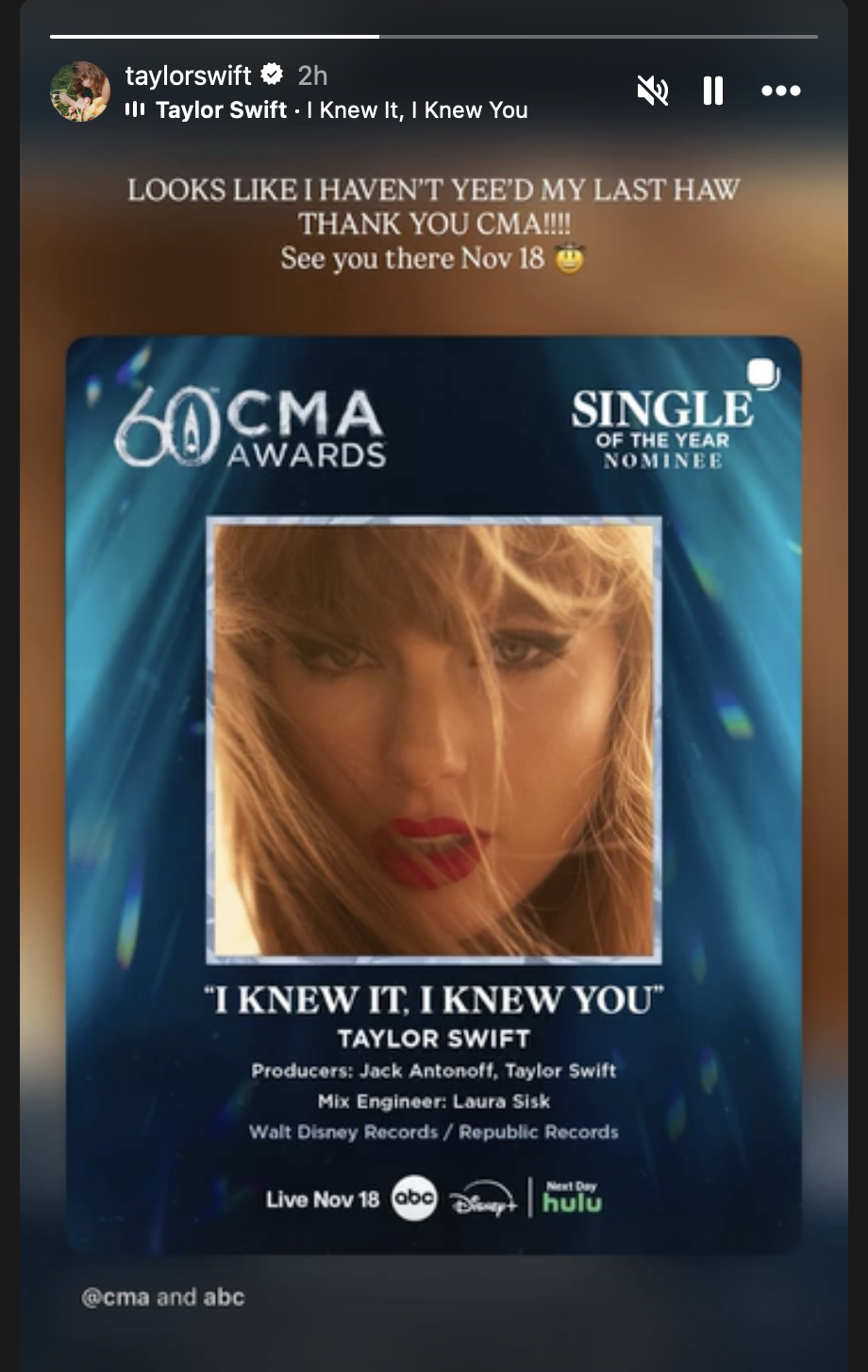
Taylor Swift Will Attend the CMA Awards for the First Time in a Decade
She normally leaves everyone guessing about award-show appearances, and this time she confirmed within hours of the nomination being announced.
Ella Langley Took Nine CMA Nominations and Came One Short of a Record Set in 2002
The scale of her year is clearest not in her own nine nominations but in how many other people were nominated for work they did on her records.